How Casino Culture Can Frame a Campus Discussion at Quy Nhon University
Casino culture gives Quy Nhon University students a paper-based way to examine game rules, visible information, and chance without wagering or broad claims.
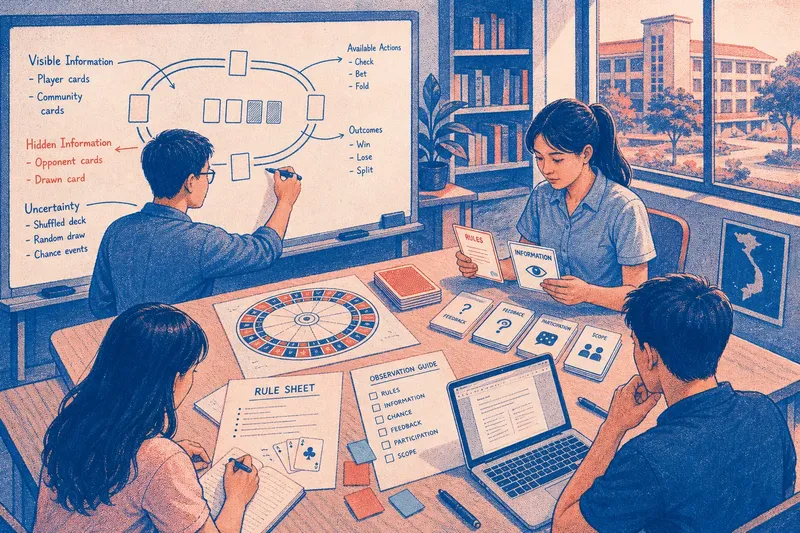
A student sketches a card table on the whiteboard while a classmate sorts rule cards beside it. At Quy Nhon University, casino culture can give that scene a focused subject: how games present choices, uncertainty, and rules for discussion without wagering.
The distinction matters. A classroom can analyze a game’s design, but that activity does not tell us what people across Quy Nhon think or do. Keeping the focus on the material in front of students makes the lesson more precise—and more useful.
What can casino culture show about game design?
Casino games make rules and choices easy to examine. Students can identify which moves are allowed, what information is visible, and which outcomes depend on chance. Those features connect naturally to questions in communication, mathematics, economics, and design.
The point is not to treat a game as a guide to real-life decisions. Instead, students can ask how its layout presents options, how a rule shapes the next move, or what information a player lacks. A roulette diagram, a printed card-game rule sheet, or a screenshot of a game interface can each provide material for close analysis.
How can students compare games without wagering?
A class can work from a diagram, printed rules, or an unplayed deck of cards. Ask students to mark the available actions, the information each player can see, and the elements that remain uncertain. No bets or money are needed to discuss how a game is structured.
Comparisons are clearest when students separate rules, information, and chance. A roulette diagram can illustrate repeated outcomes shaped by chance; a card-game diagram can show how visible cards and hidden cards affect the choices on offer. The comparison describes different formats, not which game is better or more rewarding.
What should students check in a game-design discussion?
A whiteboard, sticky notes, a printed rule sheet, and a shared Google Doc can help a group record observations. For each item below, students should note what they can actually see in the material, then choose a next action based on that observation.
- Rules: Check whether the rule sheet names each legal move. If a move is unclear, mark the missing explanation and ask for a clearer rule; if each move is identifiable, list the available choices.
- Information: Check which cards, symbols, or instructions are visible. If some information is hidden, note who can access it and compare the resulting choices; if all information is visible, examine how that changes the decision.
- Chance: Check whether a random draw, spin, or shuffle affects an outcome. If it does, label that element as chance; if it does not, identify the rule or player choice that shapes the result instead.
- Feedback: Check what the game displays after a move. If it highlights a win or near miss, describe that feature without assuming its effect on every player; if it gives little feedback, discuss what information the player receives next.
- Participation: Check whether students can contribute without playing. If not, offer roles such as rule reader or diagram maker; if they can, let each student choose a role suited to the discussion.
- Scope: Check whether a claim is about the game material or about Quy Nhon residents. If it concerns residents, ask what evidence beyond the classroom would be needed; if it concerns the material, state the observation narrowly.
How does casino culture fit regional learning?
Regional learning can examine how an idea changes as it moves between settings, without treating one classroom as a stand-in for a whole place. Students at Quy Nhon University might compare how a game’s rules are explained to newcomers or how its images signal uncertainty. Those are questions about the examples under discussion, not conclusions about regional identity.
This boundary also helps students write more clearly. “The group identified hidden information in the card-game diagram” describes a classroom observation. “People in Quy Nhon respond to hidden information this way” makes a broader claim that the activity alone cannot support.
What questions do students ask about casino culture on campus?
Can students study casino games without playing for money?
Yes. A printed rule sheet, diagram, or interface image can support analysis without wagering. Students can focus on rules, information, chance, and design.
How do chance and strategy differ?
Chance refers to an uncertain outcome, such as a card drawn from a shuffled deck, while strategy refers to a player’s choices within the rules. A game may include both, so students can identify which parts are chosen and which remain uncertain.
How can a class discuss gambling responsibly?
Keep the conversation educational and avoid presenting gambling as a dependable source of income. If a student raises a personal health, financial, or legal concern, respond with general care and suggest speaking with a qualified professional.
What can students say about a classroom discussion?
They can name the material they examined and the feature they noticed, such as how a diagram distinguishes visible from hidden information. They should not treat classmates’ comments as evidence of what local residents think or do.
What does a worked classroom activity look like?
Imagine a class uses an invented card-game rule sheet with a made-up starting setup: each player receives two face-up cards, then draws one card from a shuffled deck and chooses whether to keep it or replace it. These quantities and rules are invented for the activity, not details of a commercial game.
First, students underline the two listed actions: keep the drawn card or replace it. Next, they circle the three visible cards—the two starting cards and the new draw—and mark the shuffled deck as the source of uncertainty. Then they write the result: the player chooses between keeping known information and accepting an unknown replacement. The decision rule for the discussion is simple: call the cards visible information, call the shuffled draw uncertain, and describe the choice as a tradeoff between those conditions. No conclusion about actual players or residents follows from this invented exercise.
How can students share their observations accurately?
A short class note can name the material, the design question, and the distinction students made. For example: “The group compared visible cards with a random draw in an invented game model.” That wording communicates what happened in class without turning casino culture into a claim about regional identity.
For a discussion at Quy Nhon University, casino culture is most useful when students can point to a specific rule, symbol, or information gap and explain what it lets them say. Naming the boundary of a claim is part of the learning: it shows where the classroom observation ends and where a different kind of evidence would be needed.